




June proved to be a month of extremes for the National Electricity Market (NEM), with two major events on June 12 and June 26 sending the average price for the month soaring. The average price in New South Wales doubled compared to May, while Victoria and South Australia experienced a threefold increase.
Both high-price days were driven by near-identical conditions: extremely cold and still weather across eastern Australia leading to significantly reduced wind generation and higher electricity demand, unplanned outages at major coal generation units in New South Wales and Victoria, and the concentration of market pricing power in the hands of a small number of participants with remaining generation capacity.
12 June: Recording-breaking prices across the NEM
Thursday 12 June marked the highest average daily price in the history of the NEM. All 5 states recorded extended high prices during the evening peak, with nearly four hours of prices averaging just over $9,000/MWh. Simultaneous multi-state high-price events are rare – and this one lasted longer than most had anticipated.
Though planned maintenance is generally avoided in winter, multiple coal units were offline due to unplanned outages – one in NSW and three in Victoria, representing 25% of the state’s coal generation. Unplanned outages have been a recurring driver of high-price events over the past year.
Weather brought very cold and still conditions across eastern Australia, leading to strong demand but weak renewable output. Peak demand was 7% below the previous 15-year winter record set in 2024, yet wind contributed only 3% of the generation during the event, far below the monthly average of 17%.
Battery storage outperformed wind, contributing 3.2% of generation over the event. However, most batteries have just 1–2 hours of storage, meaning their contribution dropped from 4.5% in the first two hours to just 1.5% thereafter as storage depleted – one reason the price event lasted longer than expected.
26 June: Prices continue to soar
Two weeks later, Thursday 26 June delivered even steeper daily average prices in New South Wales, Victoria, and South Australia. Prices during the four-hour evening peak averaged $10,000/MWh. Queensland, however, avoided the high price spikes thanks to a combination of lower demand, high wind generation, and additional hydro generation capacity which helped keep prices low until the QLD-NSW interconnector reached its transfer limit.
Again, coal outages played a central role: Two coal units in New South Wales and two units in Victoria were offline for unplanned maintenance. Wind generation was almost non-existent during the event, contributing just 2.6% of total output. While Queensland had higher wind output, it couldn’t support the southern states due to transmission constraints.
Batteries provided more power during the peak event than wind, contributing 2.9% of generation. Despite stretching their output lower and longer than earlier in the month, providing 3.4% of output for the first 3 hours, their depleting storage made only a 1.3% contribution over the most expensive hour of the event. Despite the severe price spikes, there was no Lack of Reserve (LOR) declared for any state, indicating that there was sufficient capacity but with limited competition among remaining generators, those with capacity were able to bid at very high prices.
New record for wind generation
In stark contrast, just three days before the June 26th event, the NEM set a new wind generation record of 9,491 MW at 10:35pm on the 23rd of June. In that window, wind generation contributed over 39% of total grid-scale generation, and over 33% for the whole day. Similarly, just days before the June 12th event, wind contributed over 30% of the total grid-scale generation.
These extremes underscore the growing importance of battery storage in the NEM. We’re seeing rapid increases not just in capacity, but also in duration, as longer storage becomes vital for managing volatility and enabling a smoother transition to renewables.
The role of price spikes and demand response
The two high-price events on June 12 and 26 (just eight hours combined), contributed around 40% of the monthly average wholesale price. This highlights the value of demand response for customers exposed to market pricing (such as those on Flow Power’s plans). Reducing load during peak price periods can deliver substantial cost savings while supporting grid stability and the transition to renewables.
The increasing importance of batteries
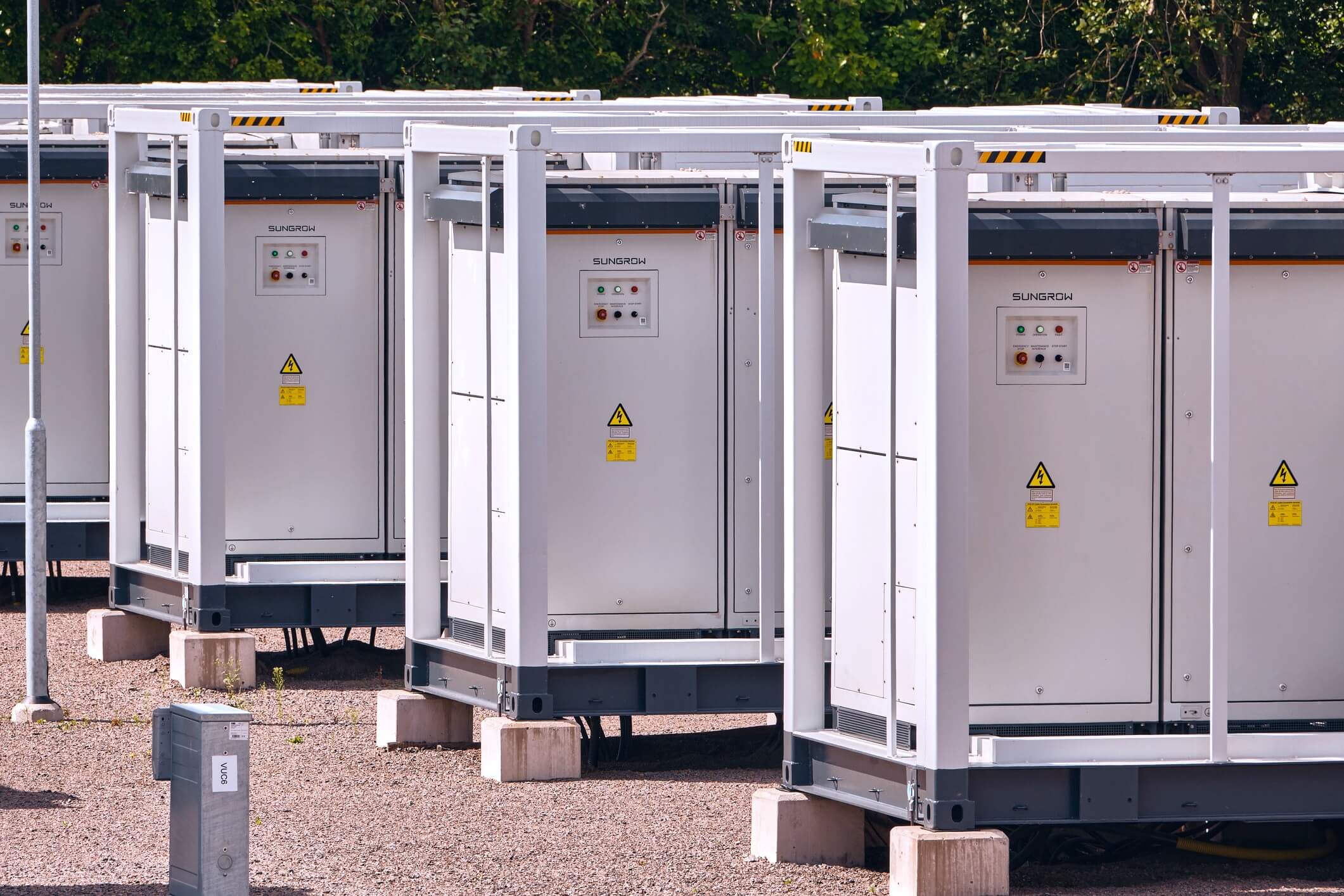
June’s volatility also highlights the increasingly vital role of batteries in the NEM. Battery adoption, both grid-scale and behind-the-meter, is accelerating with growing diversity among project owners helping to improve competition. Many new projects are targeting longer-duration storage, supported by falling battery prices and growing opportunities to arbitrage wider daily price spreads.
This shift is important as the Frequency Control and Ancillary Services (FCAS) market—once a key revenue stream for batteries—is becoming saturated. Instead of making the majority of revenue in FCAS markets, longer-duration batteries can better capture multi-hour high-price events, like those in June, offering better risk management and revenue opportunities.
As seen in the two high price events in June, most current batteries were unable to maintain output through the full duration of high-price period and prices remained high or even increased after the 2-hour window. A 4-hour battery could have captured more of the price event and helped stabilise the market.
While price spikes are costly in the short term, they do act as a price signal that can ultimately lead to a more resilient and affordable energy system. These events help create the business case for investment in more storage, batteries with longer duration, demand response and demand-side flexibility. With these additional investments, the impacts of coal outages or low wind conditions could be more easily managed without prices reaching these extreme levels.
How Flow Power customers can respond
For Flow Power customers with exposure to wholesale prices, tools like batteries and demand response offer significant savings during volatile market events. By reducing or shifting load during peak price periods, businesses can take control of their energy costs and support the broader energy transition.
Our energy experts can help you evaluate the potential of behind-the-meter batteries or optimise your load response. As June demonstrated, being proactive during price volatility isn’t just smart – it can be profitable.
Changes in forward contract prices for CY27
Forward prices for 12-month electricity futures in NEM regions rose marginally throughout June but remain below levels seen at the same time last year.
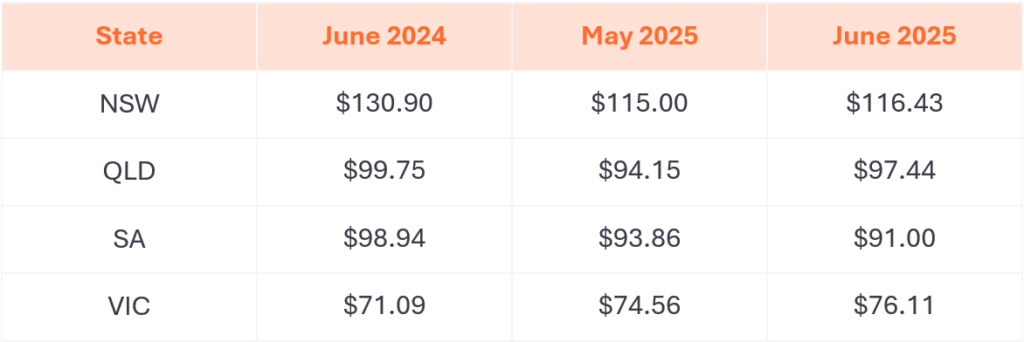
- New South Wales prices are down 11% from a year ago, and up 1% from May 2025
- Queensland prices are down 2% from a year ago, and up 3% from April 2025
- South Australia prices are down 8% from a year ago, and 3% from April 2025
- Victoria prices are up 7% from a year ago, and 2% from April 2025
June 2025 NEM insights by state
New South Wales
- Average spot price of $256/MWh, with 22 hours of negative prices and 32 hours above $300/MWh
- $200/MWh difference in average underlying spot prices at the cheapest and most expensive times of day
- No daily intervals with an average negative price over the whole month
- 28% total renewable generation through the month
- Minimum demand of 6,052 MW
- Peak demand of 12,520 MW
Queensland
- Average spot price of $169/MWh, with 86 hours of negative prices and 24 hours above $300/MWh
- $200/MWh difference between the average underlying prices at the cheapest and most expensive times of day
- No daily intervals with an average negative price over the whole month
- 28% total renewable generation through the month
- Minimum demand of 4,231 MW
- Peak demand of 8,781 MW
South Australia
- Average spot price of $250/MWh, with 108 hours of negative prices and 52 hours above $300/MWh
- $150/MWh difference between the average underlying prices at the cheapest and most expensive times of the day
- No daily intervals with an average negative price over the whole month
- 66% total renewable generation through the month
- Minimum demand of 666 MW
- Peak demand of 2,599 MW
Tasmania
- Average spot price of $219/MWh, with 5 hours of negative prices and 27 hours above $300/MWh
- $90/MWh difference between lowest and highest time-based average underlying spot price
- No daily intervals with an average negative price over the whole month
- 98% total renewable generation through the month
- Minimum record of 994 MW
- Peak demand of 1,654 MW
Victoria
- Average spot price of $265/MWh, with 33 hours of negative prices and 46 hours above $300/MWh
- $130/MWh difference between lowest and highest time-based average underlying spot price
- No daily intervals with an average negative price over the whole month
- 38% total renewable generation through the month
- New minimum demand record of 3,525 MW
- Peak demand of 8,931 MW
Looking ahead to July 2025
July started with a significant price event in South Australia, where wholesale prices remained elevated for more than 5 hours on the evening of July 2nd. This event was driven by a combination of cold, still weather increased demand and reduced wind output, alongside planned transmission maintenance work that limited the state’s interconnector with Victoria.
Interconnector limitations between Victoria and South Australia are expected to continue through July and early August. While these limitations can suppress prices during periods of high local wind generation, they also increase the risk of price volatility when weather conditions reduce renewable output. South Australia will remain particularly vulnerable to sharp price movements under similar weather patterns.
Following the high price event on June 26, ASX futures prices for Q3 jumped ~10% but have since returned to previous levels. The improvement of coal generation availability in the two weeks following the event, reducing the likelihood of further high prices. However, on 10 July, one coal unit in New South Wales and another in Victoria came offline for unplanned maintenance.
Volatility risks remain despite calmer conditions
As long as unplanned generation outages persist, the market remains exposed to potential price shocks when high demand, low renewable output, and transmission constraints occur simultaneously. While the second week of July has seen relatively calm market conditions, the underlying risks remain.
From 11 to 19 July, transmission maintenance in southern NSW will further increase the risk of elevated prices in the region, particularly if additional generation outages arise during this window.
On a more positive note, gas storage levels remain healthy as we approach the midpoint of the winter risk period. Iona gas storage is currently at 65% full, compared to 53% at the same time last year. This suggests that while there is sufficient energy in the system overall, available generation capacity will continue to be a key driver of market outcomes in the weeks ahead.
Any questions? Our energy specialists are here to help.
If you’re an existing Flow Power customer, don’t hesitate to reach out to your account manager.
If you’re not a Flow Power customer, feel free to contact our friendly team:
1300 08 06 08