




Low price spring continues
After sharp falls from August to September, electricity prices across the National Electricity Market (NEM) were broadly steady through October. Prices edged down slightly in Victoria, South Australia and Tasmania, and rose modestly in Queensland and New South Wales. Despite ongoing generator and transmission outages, strong renewable output and the absence of significant heat meant price volatility remained low.
Negative spot prices were common across the NEM – particularly during solar hours, windy periods and weekends. Prices were negative 26% of the time in New South Wales, 32% in Queensland, 42% in Victoria, and 46% in South Australia. Driven by abundant renewable generation, this prevalence of negative prices saw Tasmania, South Australia and Victoria record the lowest average prices for the month. Tasmania continued to benefit from strong hydro availability and restricted flows to the mainland.
In South Australia, monthly average prices were negative between 9:50am and 4:50pm, providing a clear signal to customers exposed to spot prices (such as those on Flow Power plans) to shift consumption into these low-cost hours. Spring’s combination of lower demand and high renewable output also leads to significant curtailment (spill), making negative prices an important incentive for better utilisation of renewable resources, including battery charging and flexible load shifting.
Renewable records topple
As renewable capacity continues to grow, new records are expected each year. Spring regularly delivers these milestones as longer, sunnier days boost solar output.
Victoria set a new renewable penetration record of 82.5% at 2pm on 16 October, surpassing the December 2024 record by 4.5%. Wind supplied 37%, rooftop solar 29%, and grid-scale solar 15%.
New South Wales set a new renewable record of 86.0% on 11 October, beating a record set just eight days earlier.
On the same day, just before midday, the NEM-wide renewable penetration record rose to 78.6%, up from the previous 76.4% in September. Rooftop solar was the largest contributor at 51%.
Across October, renewables generated more electricity than fossil-fueled plant – a strong indicator of the system’s evolving supply mix.
Signs of demand growth in Queensland
Electricity demand across the NEM is forecast to grow substantially over the next 25 years, driven by electrification of vehicles, industry, and buildings, as well as economic and population growth. Depending on scenarios and assumptions, demand could nearly double to more than five-fold by 2050.
These long-term trends can be difficult to observe month-to-month, however, Queensland is already showing clear signs of growth.
On 27 October, Queensland recorded an exceptionally high demand day, with the peak more than 15% higher than the next-highest day of the month. This was a record level of demand outside summer, and prior to January 2024, would have exceeded Queensland’s all-time maximum. Extreme weather drove the outcome, with Brisbane reaching 38.7°C and humid, rainy conditions.
Underlying trends strengthening
Weather drives short-term outcomes, but economic and population growth are lifting underlying usage:
- 11 days in October 2025 recorded higher peak demand than any day in October 2024.
- Peak demand on 19 days would have ranked in the top three days of October 2024.
- Only three days had peak demand levels that would fall in the lower half of the 2024 distribution.
Queensland is now the only state with a reliability gap in 2025–26, as identified in AEMO’s latest Electricity Statement of Opportunities. With hot summer conditions possible, demand-flexible customers can reduce costs and support system security by shifting or reducing usage during high-price periods.
Coal generator maintenance outages ramp up
Coal plant maintenance in NSW took five of the twelve coal generating units offline in September. Three of these units will remain offline into November and December, raising reliability concerns as we move into summer and peak demand risks increase. Monitoring return-to-service dates will be critical in managing forward expectations.
Transmission maintenance risks ease in New South Wales
New South Wales and Queensland experienced significant volatility in late 2024 due to transmission maintenance in southern NSW, which constrained flows from Victoria and southern NSW into Sydney. These constraints coincided with coal outages, compounding supply pressures.
Similar outages continued through October and November this year, raising the risk of high evening-peak prices, particularly if demand unexpectedly rises or additional outages occur. However, strong generator availability and modest demand have limited volatility so far. The NSW spot price reached the market price cap of $20,300/MWh for a single 5-minute interval on Friday 10 October, as solar output fell and peak demand coincided with transmission constraints.
Customers exposed to spot prices should remain alert to heightened risk during outage periods and can manage exposure by reducing or shifting consumption during high-price events.
Weather outlook
Despite expectations for a warmer-than-average spring, variable conditions through October and early November, including cooler fronts, have moderated the start of the season. The Bureau of Meteorology still forecasts warmer-than-usual conditions for summer, and electricity futures markets continue to indicate the potential for high prices in Q1, especially in New South Wales and Queensland.
Changes in forward contract prices for CY27
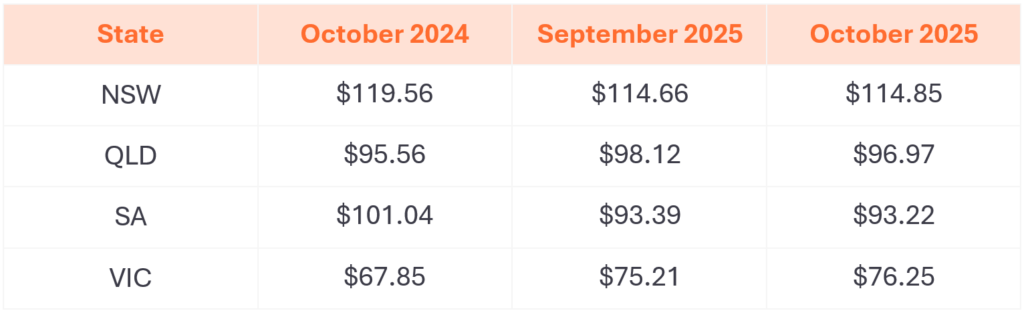
Forward contract prices for Calendar Year 2027 remained stable from August to September, with movements across all mainland regions within ±2%. This suggests steady long-term sentiment despite short-term market volatility.
October 2025 NEM insights by state
New South Wales
- Average spot price of $77/MWh, with 190 hours of negative prices and 3.5 hours above $300/MWh
- $284/MWh difference in average 30-minute spot prices at the cheapest and most expensive times of day
- Average spot price was close to $0/MWh around midday
- 47% total renewable generation through the month
- Minimum demand of 3,926 MW
- Peak demand of 11,434 MW
Queensland
- Average spot price of $56/MWh, with 238 hours of negative prices and less than 1 hour above $300/MWh
- $165/MWh difference in average 30-minute spot prices at the cheapest and most expensive times of day
- Average spot price was negative or very close to zero between 7:50 AM and 2:15 PM
- 38% total renewable generation through the month
- Minimum demand of 3,718 MW
- Peak demand of 10,709 MW
South Australia
- Average spot price of $50/MWh, with 340 hours of negative prices and 3 hours above $300/MWh
- $138/MWh difference in average 30-minute spot prices at the cheapest and most expensive times of day
- Average spot price was negative or very close to zero between 9:30 AM and 4:50 PM
- 84% total renewable generation through the month
- Minimum demand of -39 MW
- Peak demand of 1,986 MW
Tasmania
- Average spot price of $25/MWh, with 95 hours of negative prices and less than 1 hour above $300/MWh
- $33/MWh difference in average 30-minute spot prices at the cheapest and most expensive times of day
- No daily intervals with an average negative price over the whole month
- 99.98% total renewable generation through the month
- Minimum demand of 817 MW
- Peak demand of 1,461 MW
Victoria
- Average spot price of $51/MWh, with 309 hours of negative prices and less than one hour above $300/MWh
- $122/MWh difference in average 30-minute spot prices at the cheapest and most expensive times of day
- Average spot price was negative or very close to zero between 9:45 AM and 4:00 PM
- 53% total renewable generation through the month
- Minimum demand of 2,162 MW
- Peak demand of 7,364 MW
Any questions? Our energy specialists are here to help.
If you’re an existing Flow Power customer, don’t hesitate to reach out to your account manager.
If you’re not a Flow Power customer, feel free to contact our friendly team:
1300 08 06 08